
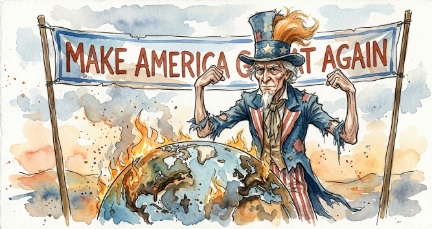
President Trump came to office promising to make America great again. Yet nearly every major element of his foreign and national-security policy does the opposite. Oh, let me count the ways:
– Weakened America’s traditional allies
– Undermined support for Ukraine
– Destabilized trade relationships
– Launched Iran war without congressional declaration
– Conducted legally questionable military ops against suspected drug boats
– Politicized and purged senior military leadership
– Attacked America’s universities and scientific establishment
– Squandered much of America’s international goodwill that constitutes our “soft power”
Each of these is disturbing, but combined they are considerably weakening our national security.
Trump is weakening America’s friends while displaying remarkable deference toward America’s adversaries.
Consider Ukraine. Russia’s invasion is not simply another European territorial dispute. It is a brutal assault by an authoritarian nuclear-armed dictator on a fledgling democracy that chose, at enormous cost, to align itself with the free world. Since 1945, supporting nations threatened by aggression has been a bedrock principle of American foreign policy. The Marshall Plan, NATO, the defense of South Korea, and America’s support for democratic nations during the Cold War all rested on the recognition that for tyrants and dictators to be held in check, democracies must stand united.
Ukraine should have been an obvious case for American leadership. Instead, Trump has repeatedly treated Ukrainian President Volodymyr Zelenskyy with hostility while expressing remarkable deference toward Vladimir Putin. Trump’s refusal to offer more robust support for Ukraine has generated profound uncertainty in Europe. The United States should be helping Ukraine defeat this unprovoked Russian invasion. Instead, Washington has repeatedly pressured Kyiv to accept compromises while seeking accommodation and business deals with Moscow. This is not merely a betrayal of Ukraine. It is a betrayal of European security.
The same pattern appears in Asia.
Trump has repeatedly expressed admiration for China’s Xi Jinping and North Korea’s Kim Jong Un, despite their authoritarian governments and their strategic opposition to the United States. His continuing fascination with Kim is particularly weird. Kim presides over a brutal dictatorship possessing nuclear weapons and missiles capable of threatening American allies and, potentially, the American homeland. Yet Trump continues to pursue personal diplomacy with Kim and speaks of him in remarkably flattering terms, apparently trying to reignite his first term self-described “love affair.” Let the love letters begin. On the other hand, Trump just ordered our military to curtail involvement in the foundational bilateral military exercise held in Korea every year, thus degrading US-Korea combat capability and cooperation.
The spectacle is extraordinary. Putin, Xi and Kim are precisely the sort of leaders whom generations of American presidents warned the world about: authoritarian rulers who suppress dissent, threaten their neighbors and reject democracy. Yet Trump consistently flatters these tyrants while denigrating our democratic allies. This behavior shames our nation, comforts our adversaries, and sews confusion and uncertainty in the rest of the world.
And the timing could hardly be worse. The United States is now at war with Iran while Russia and China maintain friendly relationships with Tehran and provide varying forms of economic, technological, diplomatic and intelligence support. China is a major purchaser of Iranian oil and has become a critical economic lifeline for Tehran. Russia has provided Iran with intelligence and other assistance, likely to include improvements to the Iranian Shahed drone, which is now licensed and produced in Russia.
At the same time, North Korea—one of the world’s most hostile anti-American regimes—has become a major military supporter of Russia’s war against Ukraine, supplying Moscow with artillery, ballistic missiles, and troops. Russia, in return, provides technical assistance that strengthens North Korea’s military capabilities, likely to include advanced missile technology.
In other words, America faces an increasingly interconnected group of adversaries while the Trump administration appears determined to create uncertainty and disunity among America’s allies. This is strategically backwards. The US should be exploiting divisions among Russia, China, Iran and North Korea; and strengthening the democratic coalition that opposes them. Instead, Trump has frequently praised the leaders of those authoritarian states while criticizing or threatening America’s traditional partners.
The damage extends beyond military alliances.
Trump’s chaotic tariff policies have transformed economic relationships with allies into recurring confrontations. Tariffs may sometimes be legitimate, but constantly changing tariffs and making tariff threats leads to chaos. Allies and businesses cannot build long-term strategies when Washington can abruptly impose or remove enormous trade barriers. Economic uncertainty is national-security uncertainty, because America’s economic prosperity is essential for its military power.
Trump’s war with Iran is an even more consequential problem. The United States has engaged in sustained military operations against Iran without Congress declaring war or enacting a specific authorization for the conflict. Whatever one thinks of Iran’s regime or its nuclear ambitions, the Constitution deliberately gives Congress the power to take the nation into war. The president’s unilateral expansion of military operations into a major conflict/war raises profound constitutional and strategic questions.
And the strategic consequences are already apparent. The war has consumed enormous quantities of American precision munitions and air-defense interceptors, putting pressure on stocks needed for other contingencies. Russia, China, and North Korea look on with glee as the US struggles and depletes itself in this foolhardy war of choice brought on by their good friend Donald.
Turning to our own hemisphere, the administration’s lethal strikes against suspected drug-smuggling boats raise another set of concerns. US. forces have conducted dozens of strikes against vessels that Washington says are connected to narcotics trafficking, killing more than 200 people. Yet in many cases the administration has released limited evidence establishing who was aboard, what the vessels were carrying or why lethal military force, rather than law enforcement, was legally justified. The distinction between policing and warfare is not a technicality. It is one of the foundations of international law and American constitutional government.
Trump’s Venezuela policy similarly demonstrates the danger of military power without a coherent democratic strategy. Removing Nicolás Maduro may have satisfied a longstanding American desire to see a brutal authoritarian regime disappear, but overthrowing a dictator is not the same thing as establishing democracy. If America’s intervention leaves the Venezuelan people without a meaningful voice in determining their own government, than we have abandoned any right to crow about being the leader of the free world. Rather, we have gone backwards, acting more like 19th century imperialists looking to conquer and control without deference to the needs or desires of the subject people.
Then there is Secretary of Defense Pete Hegseth’s purge of senior military leadership. Removing military officers because they are incompetent or because of egregious acts is legitimate, but removing experienced senior officers because loyalty to the president is more important than professional military judgment is something else entirely. Our military’s greatest institutional strength is that officers are expected to provide candid advice, even when that advice is unwelcome. A politicized military is a less effective military, and makes our nation less secure.
The same principle applies to intelligence. Presidents need intelligence agencies whose analysts tell them what the evidence shows—not what the president wants to hear. When senior military and intelligence officials are removed (as they have been) after producing analysis inconsistent with presidential claims, the danger is not merely bureaucratic. It creates an incentive for the people responsible for America’s national-security decisions to tell the president what he wants to hear.
Trump is also damaging another extraordinarily important component of American power: the nation’s scientific and educational infrastructure. American universities and research institutions have for decades attracted the world’s brightest scientists and engineers. Government-funded research, universities, private industry and international scientific collaboration helped produce the technologies that underpin America’s economic and military superiority.
Trump is attacking that ecosystem in the name of ideological and political objectives. Yes, some of these institutions may need to correct to more balanced views, but they should not be bludgeoned to death. The administration’s research cuts and restrictions on foreign researchers are driving talent elsewhere. Other countries are now actively recruiting American scientists from leading universities. America’s competitors do not have to steal our technology if the world’s best scientists are persuaded to take their talents elsewhere.
Perhaps the greatest damage, however, is Trump’s damage to America’s reputation.
For three quarters of a century, American power has rested on more than aircraft carriers and nuclear weapons. Nations have wanted to work with us. Foreign students have wanted to study here. Scientists have wanted to conduct research here. Countries have trusted American security guarantees. Businesses have trusted the fairness of American laws, and have wanted access to American markets. Democracies have looked to Washington for leadership. That accumulated trust, and desire to collaborate with America, is what diplomats call soft power. Trump is degrading it recklessly.
The United States is still enormously powerful. It has the world’s most capable military, abundant economic resources and technological strengths. But power is useful only when it can be translated into influence. If allies doubt American commitments, if adversaries believe American policy can be manipulated through flattery or bribery, if scientists no longer want to come here, if trading partners seek alternatives to American markets, and if foreign governments increasingly view Washington as unpredictable, then America’s raw power becomes less effective.
The irony is profound. A president who promised to make America great is weakening the alliances, institutions, economic relationships and international credibility that have made America great in the first place. It will likely take a generation to offset the damage Trump has brought about in these last two years. Who knows what the next two years hold. I hope Congress can get its act together and limit the damage.
Good luck everybody.

