
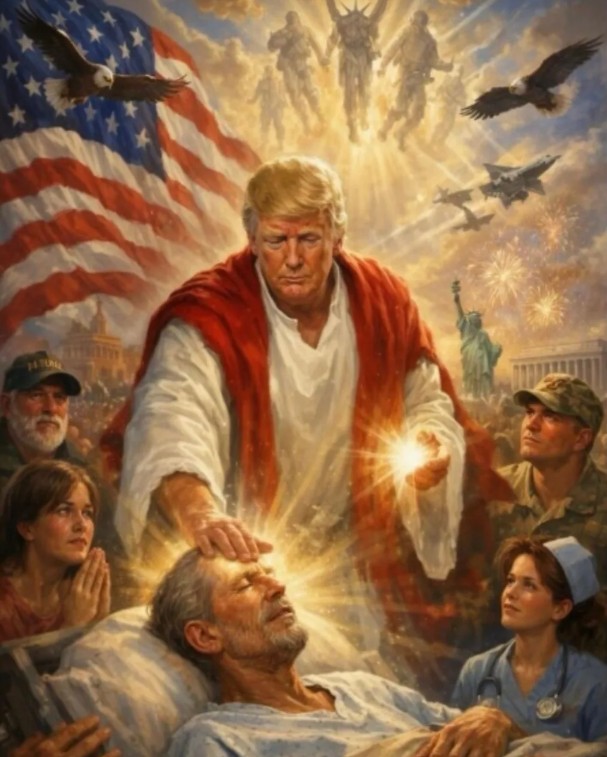
“It’s supposed to be as a doctor making people better,” he said. “And I do make people better. I make people a lot better.”
He later told CBS News that he removed the image because he “didn’t want to have anybody be confused. People were confused”.
Introduction
The political alliance between White evangelical Christians and Donald Trump stands as one of the most defining dynamics in modern American history. For over a decade, this group has served as the unyielding bedrock of Trump’s right-wing populist movement. However, by embedding their institutional identity into his populist platform, the religious movement inextricably tethered its own public credibility to Trump’s personal conduct and governing legacy. As Trump’s popularity suffers a dramatic, widespread decline in 2026, the White evangelical community is facing severe collateral damage. Because they have remained his most ardent and vocal apologists, the erosion of Trump’s presidency has triggered a parallel decay in the moral authority and institutional credibility of White evangelical Christianity.
The Unbroken 80% Alliance (2016–2024)
To understand the magnitude of the current cultural fracture, it is first necessary to examine the near-total uniformity of this evangelical-Trump voting bloc over his three consecutive presidential campaigns. Far from fracturing under the weight of compounding controversies, this transactional alliance consolidated over a decade:
- The Historical Baseline: In both the 2016 and 2020 presidential cycles, national exit polls consistently demonstrated that roughly 80% of White evangelical Christians backed Trump’s “America First” agenda. [1]
- The 2024 Consolidation: Any expectations that Trump’s mounting legal battles or indictments would alienate his religious base were thoroughly dismantled in the 2024 presidential election. Final exit polls verified that White evangelicals—who comprised roughly 27% of the total electorate—backed Trump by an overwhelming 82% to 17% margin over Kamala Harris. [1]
This historic 82% benchmark was widely viewed as the structural foundation of Trump’s return to power. Prominent faith leaders explicitly cast his political survival as a divine appointment, providing a robust theological shield that neutralized traditional evangelical concerns regarding personal morality and character. [1]
Driving the Decline: Global Tariffs, Inflation, and Plutocracy
By the summer of 2026, the absolute domestic dominance Trump enjoyed at the start of his second term has deeply fractured. This dramatic decline in national popularity is driven by structural policy failures that have alienated independent voters and frayed his working-class populist coalition:
1. Worldwide Tariff Confusion and Spiraling Inflation
Trump’s chaotic global tariff policies has brought widespread economic instability. The aggressive weaponization of import duties has disrupted international supply chains and triggered retaliatory measures from trading partners worldwide. Rather than protecting domestic industries, nonpartisan economic data demonstrates that these sweeping tariffs have functioned as a massive consumer tax. The subsequent surge in inflation has dramatically increased daily living costs for working-class households, driving Trump’s national economic approval rating down to historic lows.
2. Fixation on Personal Branding and Corrupt Enrichment
The populist promise to “drain the swamp” has been increasingly eclipsed by compounding criticisms of Trump’s systemic corruption and personal enrichment. State visits, diplomatic events, and administrative functions are routinely channeled through Trump-branded properties, generating direct revenue for his family’s private corporate empire. Beyond real estate self-dealing, Trump has expanded into massive digital operations. According to public financial disclosures, the president personally netted over $1.4 billion in a single year from family-backed cryptocurrency ventures, including his World Liberty Financial platform and royalties from personal meme coin sales, while simultaneously receiving hundreds of thousands of dollars in lavish gifts from wealthy interests. This blatant conflation of public office with private financial gain has alienated voters who feel the executive branch is being utilized as a corrupt money-making apparatus rather than a vehicle for public service.
3. Coziness with the Billionaire Class
Despite a campaign rhetoric explicitly calibrated to champion the American working class, the administration’s legislative and regulatory priorities have leaned heavily toward the nation’s financial elite. Sweeping deregulatory actions, specialized corporate tax exemptions, and private closed-door summits with tech and finance magnates have fostered a growing public consensus that the administration is deeply beholden to the billionaire class. This stark alignment with concentrated wealth has fundamentally undermined Trump’s populist credibility, exposing a widening chasm between his anti-elitist rhetoric and his plutocratic policies.
The 2026 Fracture: The 64% Drop
Because White evangelicals have historically operated as a politically immovable demographic, even marginal shifts within this group carry immense structural significance. The compounding weight of economic anxiety and governing chaos finally breached the evangelical firewall in the spring of 2026.
According to an NPR/PBS News/Marist Poll conducted in late April 2026, Trump’s job approval rating among White evangelical Christians dropped sharply to 64%. This marked a dramatic five-point erosion from just three months prior in January, and a substantial 20-point net decline from the honeymoon period of his second inauguration.
The Collateral Decay of Evangelical Credibility
As the centerpiece of their political architecture experiences a visible contraction, the White evangelical movement is suffering severe, compounding damage to its institutional authority and cultural relevance. By operating as Trump’s staunchest defenders throughout global trade wars, inflationary spikes, and corporate self-dealing, the evangelical movement has structurally compromised its core witness in three profound ways:
1. The Total Abdication of Moral Authority
For generations, the evangelical establishment operated under the banner of the “Moral Majority,” assertively arguing that personal integrity, marital fidelity, and objective ethical standards were absolute prerequisites for political leadership. By entirely abandoning these foundational principles to defend Trump’s unconventional (and un-Christian) conduct, volatile foreign policy, and financial self-enrichment, the movement has lost its ability to claim a coherent moral framework. Sociological tracking from the Public Religion Research Institute (PRRI) reveals that a commanding majority of non-evangelical Americans now view the evangelical movement primarily as a hyper-partisan political interest group, rather than a spiritual body.
2. The Acceleration of “Dechurching” and Generational Flight
The most enduring institutional damage is reflected in the rapid secularization of younger generations. Religious scholars and demographers document an unprecedented phenomenon known as “the great dechurching,” driven in massive part by political backlash. Young adults are abandoning evangelical congregations at historic rates, explicitly citing the church’s uncritical defense of Donald Trump as a primary reason. (2)
3. Deepening Internal Fractures
The drop to 64% approval has ignited bitter internal feuds within the church itself. Dissident pastors, local theologians, and younger congregants are increasingly pushing back against an entrenched leadership structure that continues to tether the Gospel to a singular political figure. This internal civil war has fractured denominations, turned local churches into political monocultures, and alienated moderate believers who feel their spiritual communities have been entirely subverted by secular partisan loyalty.
Conclusion
The symbiotic relationship between White evangelicals and Donald Trump has entered a volatile and costly phase. By tying their spiritual identity to his MAGA movement, evangelical leaders achieved historic judicial and legislative victories during Trump’s first term. However, in 2026, the structural costs of that alliance have come due. As Trump’s national popularity erodes under the weight of worldwide tariff confusion, systemic inflation, transparent corporate favoritism, and the self-dealing of the Trump clan, the church is left holding the reputational bill. By acting as primary defenders of the MAGA movement, white evangelicals have insured that the dramatic decline of Trump has triggered a parallel, generational decline in the moral credibility and internal cohesion of white evangelical churches in America.
footnotes
1. Public Religion Research Institute (PRRI)
2. July 2026 study conducted by the Wheaton College Billy Graham Center Research Institute, This nationwide survey of 2,365 Generation Z adults (ages 18 to 28) revealed that nearly half (48%) agreed that Christians’ support of Trump has made them less likely to go to church.
- The Religious Breakdown: Even among young people who already identify as religious, the Trump-evangelical alliance was cited as a major barrier. Specifically, 44% of generic Gen Z Christians and 30% of Protestant young adults stated they were completely turned off by the church’s connection to Donald Trump.
- Above data as reported at https://www.christianpost.com/news/half-of-gen-z-says-trump-support-keeps-them-out-of-church-study.html
- Rick Richardson, professor of evangelism and leadership at Wheaton College and the study’s lead researcher, says the research is yet unpublished and being adapted into a book.

