
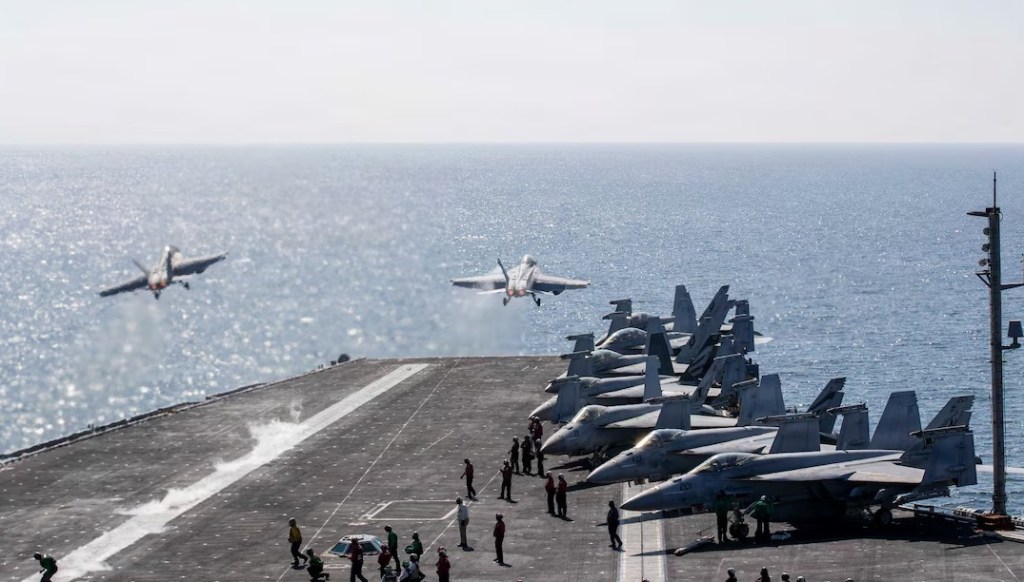
President Donald Trump issued a national security memorandum (August 13, 2026) directing the Pentagon to produce, within 60 days, a plan to replace the US. Navy’s Electromagnetic Aircraft Launch System (EMALS) and Advanced Weapons Elevators on the under-construction USS Doris Miller (CVN-81) and subsequent Ford-class aircraft carriers with older steam-powered catapults and hydraulic systems. While the memorandum does not itself order the immediate removal of existing equipment, it signals the administration’s intent to reverse one of the Navy’s most significant technological modernization efforts. The directive has been widely reported by the Associated Press, Reuters, The Wall Street Journal, Breaking Defense, and The Hill.
A History of Grievance Against Modern Magnets
This directive is not an isolated policy decision but the culmination of nearly a decade of President Trump’s public criticism of EMALS and advanced electromagnetic technologies. Since at least 2017, he has repeatedly derided the system in interviews, campaign rallies, and public appearances, often expressing a colorful preference for “goddamn steam.”
During a January 2024 campaign appearance in Iowa, Trump questioned the reliability of electromagnetic technology, remarking that “you drop a glass of water on them, that’s the end of the magnets,” and wondered aloud why companies such as John Deere were not designing the Navy’s weapons elevators. Naval engineers and defense experts widely dismissed those comments as reflecting fundamental misunderstandings of how the systems actually operate. Today, those long-held personal views have evolved from campaign rhetoric into an official presidential directive requiring the Pentagon to prepare a plan for implementing them.
Replacing Engineering Judgment with Presidential Instinct
This directive represents a striking example of personal intuition displacing the consensus judgment of the engineers, naval architects, and military planners who designed America’s newest class of aircraft carriers. Like previous episodes in which scientific or technical expertise was publicly dismissed—from hurricane forecasts altered with a Sharpie to repeated rejection of established climate science and public health guidance—this decision elevates presidential instinct above decades of engineering analysis and operational testing.
The Ford-class carriers were designed from the keel up around an all-electric architecture. EMALS was developed not merely as a replacement for steam catapults but as the foundation for future naval aviation, providing smoother launches, reduced maintenance, greater energy efficiency, and compatibility with emerging technologies such as unmanned aircraft and directed-energy weapons. According to the Navy, the system has now successfully completed more than 36,000 aircraft launches. Yet years of engineering development and operational experience now risk being overridden because the President has never trusted the underlying technology.
The Extraordinary Financial Cost
The financial implications are enormous.
Production of the USS Doris Miller‘s launch system is already well underway, with major components reportedly approaching the halfway point of manufacturing. Reversing course now would require abandoning substantial investments already made by Huntington Ingalls Industries, General Atomics, and numerous subcontractors.
More importantly, the Ford-class was never designed around steam distribution. Unlike the older Nimitz-class carriers, these ships lack the extensive network of high-pressure steam piping needed to operate conventional catapults. If implemented, the President’s directive would likely require an extensive structural redesign of the ship, significant engineering rework, delays to construction, and additional taxpayer costs that could reach into the billions of dollars.
Operational Consequences for the Fleet
The costs extend well beyond money.
- Reduced Personnel Efficiency: EMALS requires substantially fewer personnel to operate than legacy steam catapults. Reverting to steam would increase manpower requirements at a time when the Navy continues to struggle with recruiting and retaining enough sailors to fill thousands of fleet-wide vacancies.
- Greater Stress on Aircraft: Steam catapults deliver a more abrupt burst of acceleration, placing greater structural stress on aircraft. EMALS was specifically engineered to provide smoother, precisely controlled launches that reduce wear on expensive aircraft such as the F-35C while accommodating a wider range of aircraft weights.
- Reduced Flexibility: EMALS allows operators to tailor launch energy much more precisely than steam systems, making it better suited for both heavy strike fighters and lighter unmanned aircraft expected to play an increasingly important role in future naval warfare.
- Strategic Competition: As the United States considers replacing one of its newest military technologies with one first introduced in the 1950s, China has already adopted electromagnetic launch systems aboard its newest aircraft carriers and continues investing heavily in advanced naval technologies.
When Presidential Ego Overrides Professional Expertise
Presidents are elected to establish national priorities, not to perform detailed engineering reviews of complex weapons systems. Civilian control of the military is a cornerstone of American democracy. But effective civilian leadership depends on informed judgment and a willingness to rely on professional expertise, especially in highly technical fields.
Accommodating a President’s personal tastes may be relatively harmless when choosing artwork for the Oval Office, redesigning a ballroom, or proposing cosmetic changes to public monuments. Those decisions may satisfy political or aesthetic preferences without materially affecting the nation’s security.
Engineering America’s aircraft carriers is fundamentally different.
Aircraft carriers are among the most sophisticated machines ever constructed. Their design reflects decades of testing, thousands of engineering decisions, and the accumulated experience of generations of sailors, naval architects, and combat planners. Those decisions determine not only how effectively the ships fight, but also how safely American sailors operate them in some of the most demanding environments on Earth.
If the Navy is ultimately compelled to redesign a new generation of aircraft carriers to satisfy a President’s long-standing distrust of “magnets” rather than the considered judgment of its own engineers, Congress, military leaders, and the American public should ask hard questions before billions of additional dollars are spent and years of naval modernization are placed at risk.
The stakes extend far beyond budgets or political symbolism — it’s about combat effectiveness, the safety of the sailors who will serve aboard these ships, and ultimately the national security of the United States.
Hopefully, in 60 days, when the plan is due, the lunacy of this proposal will be clear to all–even our stable genius Commander in Chief.
Good luck everybody.

