
The rule of law in America was trashed by the justice system to allow Trump back into power, and now is being trashed by Trump himself on several fronts, to consolidate power in the executive branch, enrich himself and his cronies, and exact revenge on his enemies.
Much of America’s success is based on having a fair and impartial rule of law, free of politics and undue outside influence. “No one is above the law.” Law is administered by government officials “without fear or favor.” “Justice is blind,” that is, it will be fairly administered no matter who is involved in the case. This is the ideal of law that has served America well since inception.
The rule of law protects American civil rights: freedom of speech, freedom of religion, freedom of the press, freedom of assembly, the right to keep and bear arms, protection from unreasonable searches and seizures, the right to due process of law, and other rights enumerated in the Constitution.
The rule of law allows individuals and companies to fairly compete in the marketplace, to bring forth new business without fear corrupt politicians or other crooks can unduly affect the business or extract benefits.
The rule of law in America was systematically corrupted by the justice system itself to allow Donald Trump into office, and is now being openly flaunted by the Trump administration on several fronts.
Judge Eileen Cannon corruptly stonewalled the trial of Donald Trump in Florida for illegally retaining classified and/or national security documents at Mar a Lago (at least) and then obstructing FBI efforts to retrieve those documents. The case was clear-cut, the evidence overwhelming, but Judge Cannon bent over backwards to hinder proceedings to ensure the case never got to trial before the 2024 election.
The Supreme Court contributed to American lawlessness in at least two regards. First, it ruled that Presidents are immune from prosecution for any actions taken as President, to include the hypothetical situation introduced in court where the president orders Seal Team Six to assassinate a potential political rival. This was truly remarkable, a despicable ruling in the eyes of almost all serious legal scholars. Secondly, the Supreme Court slow-rolled rulings on the case involving the Trump-led conspiracy to obstruct the certification of the 2020 election. Again, a trial with overwhelming evidence against Trump was not given the light of day to proceed to trial before the 2024 election.
Now that Trump is in power, the reign of lawlessness is breathtaking. Below are a few examples:
– Mass Pardons for Jan. 6 Defendants. While Trump is legally allowed to pardon whoever he wants, this action contributes to a lawless society by undermining accountability, potentially encouraging future political violence, and erasing the legal consequences of the attempted subversion of Congress and the will of American voters. Trump has continued to misuse his pardon power by pardoning a rogues gallery of criminals, often, it seems for his own personal or political enrichment.
– Freezing Spending (Impoundment). In January 2025, the Trump administration (via OMB) issued a memo (M-25-13) instructing agencies to pause all discretionary grants and loans so they could be reviewed for alignment with Trump’s priorities. The memo targeted a very wide range of programs, potentially affecting trillions in funding. This is obviously a form of impoundment — the executive refusing to spend money that Congress has already appropriated. Under the Impoundment Control Act of 1974, the president is very limited in doing this unilaterally, that is, if the president is obeying the law. A federal judge (John McConnell) blocked the freeze, saying the administration was likely violating Congress’s “power of the purse.” Although the White House formally rescinded the memo, it says the underlying funding freeze “remains in full force.” This is a major separation-of-powers issue — by pausing funds unilaterally, the executive is usurping Congressional authority. Unfortunately, the lap-dog Republican Congress has not stood up to their fearless leader on this issue.
– Tariffs. Trump invoked the International Emergency Economic Powers Act (IEEPA) to justify sweeping “reciprocal” tariffs, declaring a national emergency based on trade deficits.
But courts have pushed back and stated Trump has “exceeded the authority granted under IEEPA.”
The trial court held that the “unusual and extraordinary threat” standard required by IEEPA was not met: long-term trade deficits, by themselves, do not qualify as an emergency under that law.
The court also invoked the “major-questions doctrine,” arguing that such broad economic action should require clear congressional authorization. A federal appeals court (the US. Court of Appeals for the Federal Circuit) agreed, ruling that Trump’s use of IEEPA for the tariffs was “unbounded in scope” and went beyond the “express limitations” of the statute. The case is now before the Supreme Court, where initial questioning by the justices indicate even MAGA-friendly hardliners seem to think Trump has over-reached. Standby for news.
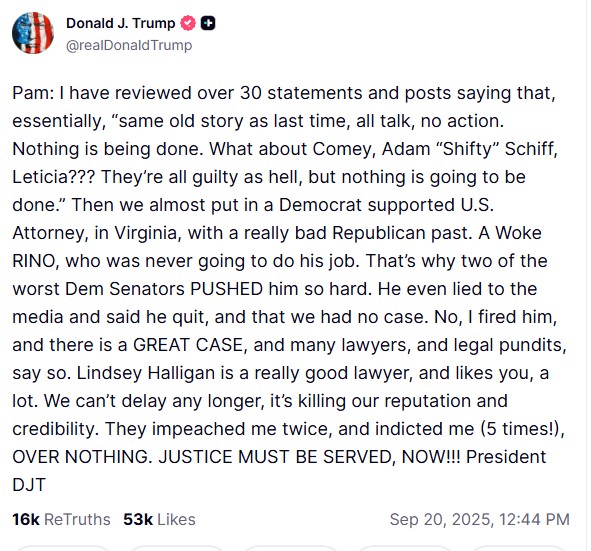
– Vindictive Prosecutions. Trump has pushed for prosecuting James Comey, the former FBI Director, on charges including lying to Congress. This case is clearly “vindictive,” supported by no credible evidence, and clearly based on Trump’s outspoken animus towards Comey. Likewise the case with New York Attorney General Letitia James, indicted in Virginia on bank fraud and false-statement charges. Both cases were initiated/indicted after Trump directed DOJ (via Truth Social) to get on with these cases, despite career prosecutors concluding there was not sufficient evidence to charge.
– DOJ Purges. The Trump DOJ reportedly fired more than a dozen career prosecutors who had worked on cases against Trump (e.g., on Jack Smith’s team). According to a fact sheet from House Democrats, top career officials in critical DOJ divisions (Criminal, Civil Rights, Public Integrity, etc.) were removed or reassigned early in Trump’s second term. Additionally, most of the Justice Department’s Public Integrity Section (which prosecutes public corruption) was gutted, and many of its lawyers were either pushed out or forced to resign. Maurene Comey, a longtime federal prosecutor (and daughter of James Comey), was terminated. She filed a lawsuit alleging her firing was retaliatory and violated civil-service protections, First and Fifth Amendment rights, and separation-of-powers principles. Her firing is part of a broader purge of experienced DOJ lawyers who might resist politically motivated prosecutions.
– Eric Adams case. More Trump meddling in the justice system is reflected in the New York Mayor Eric Adams case. Before the “accepting bribes” case could come to trial, Trump ordered DOJ to drop the case, apparently to ensure a compliant Mayor available to support Trump immigration plans, among other things. Nearly a dozen prosecutors resigned in protest after the Trump DOJ pressured them to drop the corruption case. One former prosecutor, Ryan Crosswell, said he was essentially told to “sign it, resign, or be fired” when asked to dismiss the corruption case — indicating coercion to comply with politically motivated orders.
– Trump Public Statements. Trump’s torrent of Truth Social posts to investigate, fire, or lock up perceived enemies is non-stop, and ranging from current and former government officials (e.g., Sen Adam Schiff, Rep Nancy Pelosi, Miles Taylor (former DHS), Chris Krebs (former CISA director)), to comedians (Jimmy Kimmel, Stephen Colbert, Jimmy Fallon), to news reporters and companies (ABC, CBS, MSNBC). But the important thing here is that Trump’s staff of MAGA bootlickers then takes action on these insane Trump rants, the best they can, creating a chilling effect for free speech and honesty in law enforcement.
– Use of military force in domestic law enforcement. This is perhaps the most serious of Trump’s likely illegal actions, and again we await the Supreme Court to rule on the matter. Our national security rests on a professional military to focus on external threats to the nation. The Posse Comitatus Act (PCA), enacted in 1878, bars the use of the US. military to carry out civilian law-enforcement functions. Trump has deployed active duty and federalized National Guard troops to several cities supposedly under the guise of protecting federal facilities, but courts have found in some instances those troops have acted beyond that limited mission, and so violate the PCA. Critics argue Trump is just “normalizing” these type of deployments for possible future more nefarious reasons. Additionally, Trump has also threatened several times to enact the Insurrection Act (combines several statutes from 1792 to 1871 and is found in Title 10, Chapter 13 of the US. Code). It allows the President to deploy military forces domestically in certain scenarios, such as insurrections, rebellion, or when law enforcement can’t execute the law effectively. This is dangerous, because the language is very broad and vague, giving the president almost unchecked discretion. Congress really needs to update these old laws, because, while all other presidents have adhered to the spirit of not using troops on American soil, Trump has no such discretion. Again, we await Supreme Court rulings on what Trump has so far done, with respect to PCA, and can only hope the Mad-Hatter President doesn’t invoke the Insurrection Act for spurious reasons (e.g., election meddling comes to mind).
Conclusion: Trump was ushered into office via a corrupt judicial system, and he now reigns as if King, flaunting established laws and norms, and risking the very fabric of a free and fair country.
Good luck, everybody!
 Waipahu Bob