
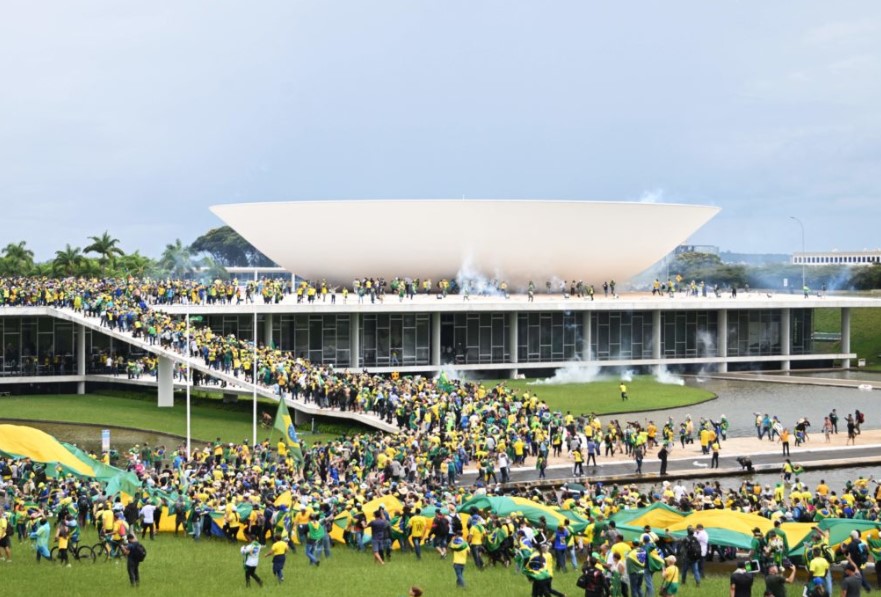
The rise of evangelical political movements in both the United States and Brazil has played a key role in undermining democratic norms and fueling authoritarian reactions to electoral defeat. Though shaped by distinct histories and contexts in the two countries, these evangelical movements shared similar strategies and messages that enabled strikingly similar attempts to overturn democratic election outcomes.
In the United States, the alliance between white evangelical Christians and President Donald Trump proves to be one of the most enduring and influential political forces of the past decade, enhancing Trump’s image to a wide swath of Americans, and vaulting politics to a more prominent role in churches across the country. This unholy marriage led to a detriment of long-standing democratic values. Evangelical leaders and media figures promoted the idea that Trump was chosen by God to lead the nation and framed his defeat in the 2020 presidential election as evidence of widespread fraud and spiritual warfare against Christian values. This narrative, amplified across churches and social media, laid the groundwork for the January 6, 2021 attack on the Capitol—a violent attempt to stop the certification of Joe Biden’s victory. The refusal to accept electoral defeat was not merely about loyalty to a candidate, but about defending a perceived divine mission against secular liberalism.
A parallel dynamic unfolded in Brazil under President Jair Bolsonaro. In a predominantly Catholic country, the Christian Evangelical population has grown from around 7% in 1980, to almost 30% today, and these Evangelicals have played an increasingly important role in Brazilian politics. Evangelicals strongly contributed to the impeachment of President Dilma Rousseff in 2016, and the election of Bolsonaro in 2018. Like Trump in America, Bolsonaro’s presidency was buoyed by strong evangelical support, with pastors and churches portraying him as a bulwark against moral decay and leftist ideology. Following Bolsonaro’s defeat in the 2022 election, Brazilian evangelical leaders and social media influencers helped spread claims that the vote had been stolen. On January 8, 2023, mobs stormed Brazil’s Congress, Supreme Court, and presidential palace in Brasília, echoing the US Capitol riot in both symbolism and motivation: a refusal to recognize a legitimate transfer of power, rooted in a belief that God’s chosen leader had been unjustly removed.
In both cases, evangelical movements provided moral and organizational legitimacy to attempts to subvert democracy. By framing political outcomes as battles between good and evil, they encouraged authoritarian reactions when faced with electoral defeat. Rather than accepting the will of the people, these movements incited mobs to reject it, ultimately threatening the very democratic systems that had enabled their rise to power.
Interestingly, and disturbingly, President Trump has now enacted a 50% tariff on Brazil (effective 1 Aug 2025), not because of a negative trade balance (the US has a trade surplus with Brazil), but because Brazil dares to hold Bolsonaro accountable in the courts for his illegal actions to subvert the will of the voters. Trump explicitly tied the tariff to the prosecution of Bolsonaro. In a July 2025 letter to Brazil’s President Lula, Trump called the trial a “witch hunt” and demanded it stop. He insisted this warranted economic consequences.
 Waipahu Bob