
George Frost Kennan (February 16, 1904 – March 17, 2005) was an American diplomat and historian.
From the diaries of George F. Kennan
Dorpat (Tartu), Estonia, March 29, 1929, attending a religious service during his stay in Estonia, awaiting stationing to the first US Embassy established in post-revolutionary Russia:
From the sight of these drab peasants, staring at the ikons, crossing themselves, shuffling the balsam twigs under their feet, as they wait for the commencement of the service, one can sense the full necessity for their presence here…. They do not understand the service, but they see the gilt and the robes and the candles; they hear the chanting and the singing; and they go away with the comforting feeling of there being a world . . . somewhere and somehow . . . less ugly than their own.
And later from Kovno (Kaunas), Lithuania, April 9, 1929: Threads of Fate, leading to all parts of Europe and America, are responsible for the fact that this scrawny Jewish village lying by its frozen river in the morning sun, may call itself the capital of the muddy, impoverished country-side which stretches out around it. It has accepted [this] . . . as a hungry animal accepts an unexpected meal. When the tide of fortune turns, when the officials and diplomats go away, leaving the government buildings as empty as the shops of the little Jewish merchants, there will be snarling and recrimination, but there will be no real sadness, for there has been no real hope.
And later, during that Russian stationing at the embassy, as a minor functionary, but respected for his insight and observations. From the letters of George F. Kennan, August 1932, in response to query as to whether the population of the USSR was content with its government:
Kennan replied, a bit pointedly, that in a country where millions of people had been killed in military operations, exiled to prison camps, or forced to emigrate—“where the ideals, principles, beliefs and social position of all but a tiny minority have been forcibly turned upside-down by government action”—and where that same regime harbored an ideologically driven hostility toward the rest of the world, “it is scarcely to be expected that most of the people should be as happy as those in other countries.” Nevertheless the army, the factory proletariat, and urban youth had benefited from Bolshevik rule: young communists in particular were “as happy as human beings can be,” having been relieved to a large extent “of the curses of egotism, romanticism, day-dreaming, introspection, and perplexity which befall the youth of bourgeois countries.” Still, this situation could not last. If the materialist phase of development succeeded, then consumerism—“autos, radios and electric ice-boxes”—would drain away ideological zeal. If it failed, anger over unkept promises would paralyze the regime. Either way, the artificiality now sustaining Soviet self-confidence would evaporate.
***************************************************************************
From the US State Dept, Office of History:
George Kennan and Containment
At the end of the war, the Soviet Union was a closed society under the iron grip of Joseph Stalin.
George Kennan
Few in the West had experience with the communist state and even fewer understood what motivated the Soviets. One man who had first hand knowledge was a Foreign Service officer, George F. Kennan. In 1946, while he was Chargé d’Affaires in Moscow, Kennan sent an 8,000-word telegram to the Department—the now-famous “long telegram”—on the aggressive nature of Stalin’s foreign policy. Kennan, writing as “Mr. X,” published an outline of his philosophy in the prestigious journal Foreign Affairs in 1947. His conclusion was that “the main element of any United States policy toward the Soviet Union must be that of a long-term patient but firm and vigilant containment of Russian expansive tendencies.” Containment provided a conceptual framework for a series of successful initiatives undertaken from 1947 to 1950 to blunt Soviet expansion.
*****************************************************************************
Kennan Quotes
The best thing we can do if we want the Russians to let us be Americans is to let the Russians be Russian.
One sometimes feels a guest of one’s time and not a member of its household.
A political society does not live to conduct foreign policy; it would be more correct to say that it conducts foreign policy in order to live.
We should cease to talk about vague and unreal objectives such as human rights, the raising of the living standards, and democratization. The day is not far off when we are going to have to deal in straight power concepts. The less we are then hampered by idealistic slogans, the better.
Were the Soviet Union to sink tomorrow under the waters of the ocean, the American military-industrial establishment would have to go on, substantially unchanged, until some other adversary could be invented. Anything else would be an unacceptable shock to the American economy.
War has a momentum of its own and it carries you away from all thoughtful intentions when you get into it. Today, if we went into Iraq, like the president would like us to do, you know where you begin. You never know where you are going to end.
Public opinion, or what passes for public opinion, is not invariably a moderating force in the jungle of politics.
Heroism is endurance for one moment more.
***********************************************************************
George F. Kennan Dies at 101; Leading Strategist of Cold War
From New York Times, March 18, 2005, By Tim Weiner and Barbara Crossette
George F. Kennan, the American diplomat who did more than any other envoy of his generation to shape United States policy during the cold war, died on Thursday night in Princeton, N.J. He was 101.
Mr. Kennan was the man to whom the White House and the Pentagon turned when they sought to understand the Soviet Union after World War II. He conceived the cold-war policy of containment, the idea that the United States should stop the global spread of Communism by diplomacy, politics, and covert action — by any means short of war.
As the State Department’s first policy planning chief in the late 1940’s, serving Secretary of State George C. Marshall, Mr. Kennan was an intellectual architect of the Marshall Plan, which sent billions of dollars of American aid to nations devastated by World War II. At the same time, he conceived a secret “political warfare” unit that aimed to roll back Communism, not merely contain it. His brainchild became the covert-operations directorate of the Central Intelligence Agency.
Though Mr. Kennan left the foreign service more than half a century ago, he continued to be a leading thinker in international affairs until his death. Since the 1950’s he had been associated with the Institute for Advanced Study in Princeton, where he was most recently a professor emeritus.
By the end of his long, productive life, Mr. Kennan had become a phenomenon in international affairs, with seminars held and books written to debate and analyze his extraordinary influence on American policy during the cold war. He was the author of 17 books, two of them Pulitzer Prize-winners, and countless articles in leading journals.
His writing, from classified cables to memoirs, was the force that made him “the nearest thing to a legend that this country’s diplomatic service has ever produced,” in the words of the historian Ronald Steel.
“He’ll be remembered as a diplomatist and a grand strategist,” said John Lewis Gaddis, a leading historian of the cold war, who is preparing a biography of Mr. Kennan. “But he saw himself as a literary figure. He would have loved to have been a poet, a novelist.”
Morton H. Halperin, who was chief of policy planning during the Clinton administration, said Mr. Kennan “set a standard that all his successors have sought to follow.”
Mr. Halperin said Mr. Kennan understood the need to talk truth to power no matter how unpopular, and made clear his belief that containment was primarily a political and diplomatic policy rather than a military one. “His career since is clear proof that no matter how important the role of the policy planning director, a private citizen can have an even greater impact with the strength of his ideas.”
The force of Mr. Kennan’s ideas brought him to power in Washington in the brief months after World War II ended and before the cold war began. In February 1946, as the second-ranking diplomat in the American Embassy in Moscow, he dispatched his famous “Long Telegram” to Washington, perhaps the best-known cable in American diplomatic history. It explained to policy makers baffled by Stalin that while Soviet power was “impervious to the logic of reason,” it was “highly sensitive to the logic of force.”
Widely circulated in Washington, the Long Telegram made Mr. Kennan famous. It evolved into an even better-known work, “The Sources of Soviet Conduct,” which Mr. Kennan published under the anonymous byline “X” in the July 1947 issue of Foreign Affairs, the journal of the Council on Foreign Relations. “Soviet pressure against the free institutions of the Western world is something that can be contained by the adroit and vigorous application of counterforce,” he wrote. That force, Kennan believed, should take the form of diplomacy and covert action, not war.
Mr. Kennan’s best-known legacy was this postwar policy of containment, “a strategy that held up awfully well,” said Mr. Gaddis.
But Mr. Kennan was deeply dismayed when the policy was associated with the immense build-up in conventional arms and nuclear weapons that characterized the cold war from the 1950’s onward. His views were always more complex than the interpretation others gave them, as he argued repeatedly in his writings. He came to deplore the growing belligerence toward Moscow that gripped Washington by the early 1950’s, setting the stage for anti-Communist witch hunts that severely dented the American foreign service.
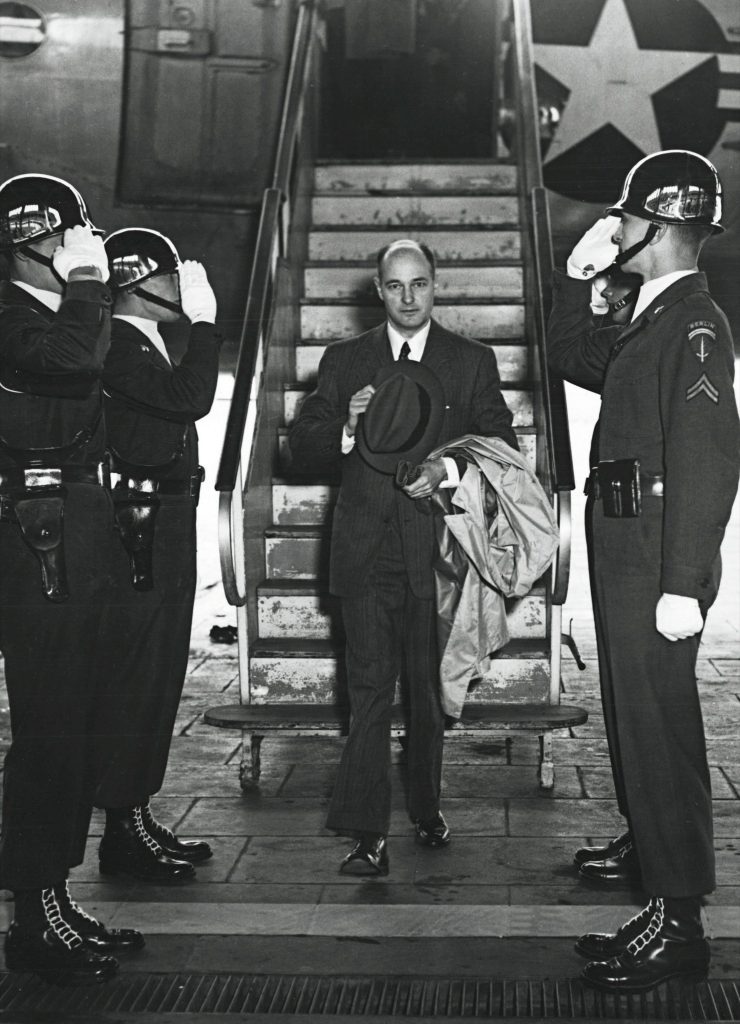
At the height of the Korean War, he temporarily left the State Department for the Institute for Advanced Study. He returned to serve as ambassador to Moscow, arriving there in March 1952.
But it was “a disastrous assignment,” Mr. Gaddis said. Mr. Kennan was placed under heavy surveillance by Soviet intelligence, which cut him off from contact with Soviet citizens. Frustrated, Mr. Kennan publicly compared living in Stalin’s Moscow to his experience as an internee in Nazi Germany. The Soviets declared him persona non grata.
From One Dulles to the Other
Mr. Kennan was then pushed out of the Foreign Service in 1953 by the new Secretary of State, John Foster Dulles, who took office under the newly elected President Eisenhower. Allen Dulles, the new director of central intelligence, then offered a post to the man his brother had rejected — knowing, as few others did, of Mr. Kennan’s crucial role in the formation of the C.I.A. clandestine service.
 Waipahu Bob